Hepatitis A Cases Reported in Onondaga County

The Onondaga County Health Department (OCHD) is investigating a recent increase in reported Hepatitis A cases in Onondaga County. Since November, five cases have been confirmed among Onondaga County residents, a significant increase from the usual number of local cases. Dr. Indu Gupta, Commissioner of Health explained that, “Although anyone can get Hepatitis A, these recent cases are a result of intravenous and other drug use and unprotected sexual activities.”

If you or a loved one may have been exposed to someone with Hepatitis A since November 23, especially through drug use and unprotected sex, it is important that you receive vaccine as soon as possible to prevent infection. Contact your healthcare provider or call OCHD at 315-435-3215 Monday-Friday, 8:30-4:30 or 315-435-3252 after hours.

The best way to prevent Hepatitis A infection is by getting vaccinated. If you or a loved one is at high risk for Hepatitis A infection, contact your healthcare provider today to get vaccinated. People who are at greater risk include those who: have sexual contact with someone who has Hepatitis A; are men who have sexual encounters with other men; use recreational drugs (injected or not); or are household members or caregivers of a person infected with Hepatitis A.

Infected individuals can spread Hepatitis A even if they don’t look or feel sick. Many children and some adults have no symptoms. If symptoms develop, they usually appear 2 to 6 weeks after exposure and can include: fever, tiredness, loss of appetite, nausea, vomiting, abdominal pain, dark urine, clay-colored stools, joint pain, and yellowing of the eyes and skin. In some cases, serious consequences can result including liver failure and death.

If you have symptoms or think you may have been exposed to someone with Hepatitis A, contact your healthcare provider or call OCHD at 315-435-3215 Mon-Fri 8:30-4:30, or 315-435-3252 after hours. For more information about the Hepatitis A virus, please visit: www.cdc.gov/hepatitis/hav/pdfs/HepAGeneralFactSheet.pdf.

Boil Water Order Lifted for Residents in the Village of Jordan and parts of the Town of Elbridge

The Onondaga County Health Department has lifted the Boil Water Order for residents and businesses in the Village of Jordan and parts of the Town of Elbridge. Laboratory results have confirmed that there is no evidence of coliform bacteria and it is safe to resume drinking tap water.

For more information about the Boil Water Order, call the Onondaga County Health Department, Division of Environmental Health at 315-435-6600.

BOIL WATER Order For Residents in the Village of Jordan and parts of the Town of Elbridge

******* FOR IMMEDIATE RELEASE *******

BOIL WATER Order For Residents in the Village of Jordan and parts of the Town of Elbridge

The Onondaga County Health Department is issuing a Boil Water Order to residents and businesses in the Village of Jordan and parts of the Town of Elbridge. The test results from routine sampling were received today that confirmed the presence of coliform bacteria.

AS A PRECAUTION DO NOT DRINK THE WATER WITHOUT BOILING IT FIRST. Bring all water to a boil, let it boil for one minute, and let it cool before using, or use bottled water certified for sale by the New York State Department of Health. Boiled or bottled water should be used for drinking, making ice, brushing teeth, washing dishes, and food preparation until further notice. Boiling kills most bacteria and other organisms in the water.The boil order will be in effect and sampling will continue in the affected areas until tests confirm there is no more coliform in the water supply.

Additional reminders for residents in this area include:

* If you use bottled water, be sure it comes from a safe source. If you do not know the source, boil or treat the water before you use it. Use only bottled, boiled, or treated water until your water supply is tested and found to be safe.

* Boiling water when practical is the preferred way to get rid of harmful bacterial and parasites. Bringing water to a boil for one minute will kill most organisms.

* You can treat water with chlorine tablets, iodine tablets, or unscented household chlorine bleach (5.25% sodium hypochlorite). If you use chlorine tablets or iodine tablets, follow the directions that come with the tablets. If you use household chlorine bleach, add 1/8 teaspoons of bleach per gallon of water if the water is clear. If the water is cloudy, add ¼ of bleach per gallon. Mix the solution thoroughly and let it stand for about 30 minutes before using it.

* While drinking water contaminated with coliform bacteria does not always cause illness, residents in the affected areas that experience gastrointestinal upset, abdominal cramps, and diarrhea should contact their healthcare provider.

For more information about the Boil Water Order, call the Onondaga County Health Department, Division of Environmental Health at 315-435-6600.

Download PDF Version

End the Stigma: Mental Illness and Substance Use Disorders

By Mariah Senecal-Reilly

In October both National Substance Abuse Prevention Month and Mental Illness Awareness Week are observed. During this time families, communities, and organizations come together to raise awareness about the importance of substance abuse prevention and to celebrate people living in recovery. According to SAMHSA, around 43.6 million (18.1%) Americans ages 18 and older and have experienced some form of mental illness. In the past year, there were 20.2 million adults (8.4%) with a substance use disorder. Of these, there were 7.9 million people with both a mental disorder and substance use disorder, which is known as having co-occurring disorders. Experiencing a substance use disorder or mental health condition is very challenging, but the isolation, blame, and secrecy created by stigma can make things much worse by creating barriers to reaching out, getting needed support and living well.

Why is this Important?
To understand why this is important, consider what stigma is and how it affects those who live with a mental health condition or substance use disorder. Stigma is defined as when someone views a person in a negative way just because of a particular circumstance, or quality that they possess. Some people describe stigma as a feeling of shame or judgment from someone else but stigma can also come from an internal place when a person confuses feeling bad with being bad.

What is it like to experience stigma?

Individuals Feeling “Apart From” Society
Having a substance use disorder or mental health condition often goes along with never feeling comfortable with who you are.  This could mean that a person feels that there is something that makes them feel less than, different or set-apart from “normal” people. Or perhaps they feel disappointed at things they have not accomplished. As a result, the ordinary facets of life that are happy and satisfying to most people do not feel that way to someone with a mental health condition or a substance use disorder.

Individuals are Less Likely to Seek Out Treatment
People who experience stigma regarding their substance use disorder or mental health condition are less likely to seek treatment due to the fear of being associated with something that is viewed negatively by society. This can result in economic, social, and medical costs.

Communities are Less Likely to Support Harm Reduction Strategies
Harm reduction refers to public health interventions such as needle exchanges; substitution therapies; safe drug consumption areas that are designed to decrease the risk associated with drug use (e.g., infected needles); and peer-led treatment options. Due to widespread stigma about people with mental health conditions or substance abuse disorders these interventions are not usually supported by the public and believed by some encourage drug use or normalize behavior they see as unusual.

Individuals Can Experience Low Self Esteem and Poor Mental Health
When a person experiences stigma it can cause serious harm to their social lives. The chronic stress of discrimination may affect the mental and social health of individuals who use drug or people with mental health conditions. They may lose touch with their community and family and experience loneliness and isolation. When a person does not have social ties or a person to talk to, they are less likely to reach out for healthcare or treatment

What Can be Done to Reduce Stigma?
Reducing stigma associated with having a substance use disorder or mental health condition increases the likelihood that people with these conditions will seek treatment and other recovery supports. There are many ways to reduce stigma, here are a few:

Inclusive Language Choices
Person first language (for example, reference to “a person with substance use disorder or a person with a mental health condition”) suggests that the person has a problem that can be addressed. By contrast, calling someone a “drug abuser or mental patient” implies that the person is the problem.
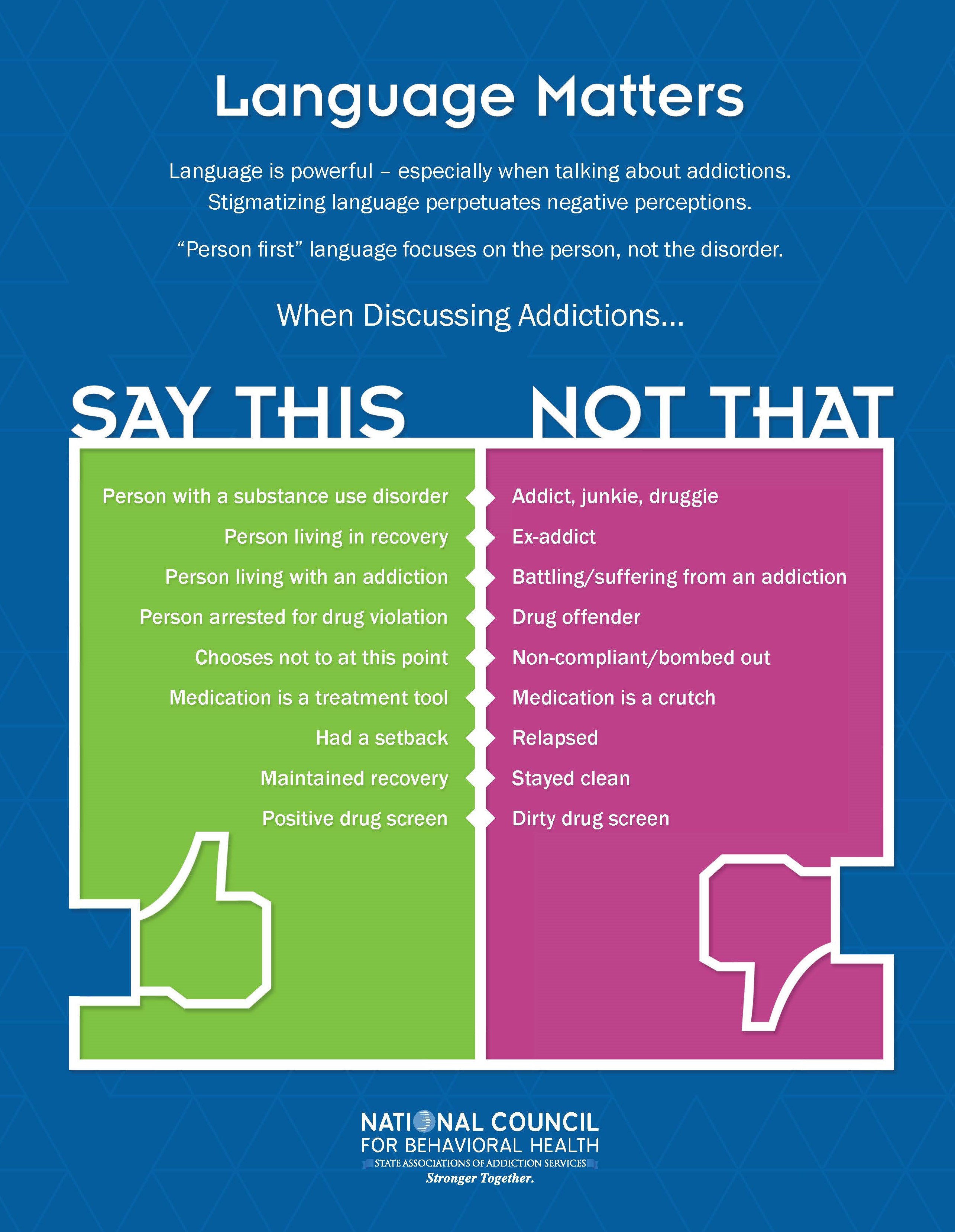
Language Matters

Increase Community Education About Stigmatized Conditions
Conducting educational campaigns and other educational anti-stigma interventions present factual information about the stigmatized condition with the goal of correcting misinformation or contradicting negative attitudes and beliefs. They counter inaccurate stereotypes or myths by replacing them with factual information. This also involves doing the same on a face to face basis when someone is spreading inaccurate information.

Increase Contact with People with Stigmatized Conditions
Across mental health conditions and substance use disorders, people without these conditions often have very little meaningful contact with those who have these conditions. Lack of contact fosters discomfort, distrust, and fear.  Learn about and engage in contact with people who have lived experience with mental health conditions and/or substance use disorder.

To find out if you are infected with stigma go to curestigma.org/ to take a quiz.
Cure Stigma

Sources:

therecoveryvillage.com

nami.org/stigma

samhsa.gov

nap.edu

Lead Poisoning Educational Forum Held

The Onondaga County Health Department and several community partners hosted a “Close the Window on Childhood Lead Poisoning” education forum earlier today. The forum featured local experts who described the strategies Onondaga County health officials and key community partners are utilizing to prevent childhood lead poisoning by addressing the issue at its source – poorly maintained housing built before 1978. Speakers provided the latest information on the Health Department’s response to children identified with an elevated blood lead test result, and community-wide efforts to improve housing conditions through partnership, improved enforcement strategies, and financial resources for property owners.

Dr. Indu Gupta, Onondaga County Health Commissioner, gave an overview of childhood lead poisoning in Onondaga County. “Onondaga County and the city of Syracuse have old housing stock built before 1978 that is likely to contain lead paint.  As long as we have older housing in our community, we will need to be diligent in monitoring children’s health and improving the prevention of childhood lead poisoning through a housing-based approach.”

Dr. Howard Weinberger from the Central/Eastern New York Regional Lead Prevention Center at Upstate Golisano Children’s Hospital stated “It is critically important that every health care provider test all children in their practice at age 1 and 2 and complete an annual risk assessment screening until the child is six years old. Only by testing can we identify children who may be in need of intervention to prevent lasting health impacts from lead exposure.”

Those in attendance at today’s forum included county and city government officials, representatives of various health and housing agencies, community-based organizations, and neighborhood advocacy groups.
Following the expert speakers, participants visited informational table displays to get more information on child blood lead testing requirements, recognizing lead-based paint hazards, and simple strategies that can be used to minimize the risk of exposure to household lead-based paint and dust in older homes.

For more information about lead poisoning prevention visit www.ongov.net/health/lead/.

Onondaga County Cancer Services Program Continues to Offer Free Cancer Screenings

The Onondaga County Health Department (OCHD) will continue to provide cancer screening services for uninsured and underinsured residents with support from the New York State Department of Health (NYSDOH). Since 1987, the Cancer Services Program (CSP) of Onondaga County has collaborated with the NYSDOH, local healthcare providers, and community agencies to offer free screening and follow up services for breast, cervical, and colon cancers to uninsured and underinsured residents of Onondaga County. Onondaga County Health Commissioner, Dr. Indu Gupta states, “While cancer is the second leading cause of death in Onondaga County, early detection and treatment often leads to better health outcomes. I am so pleased that the Onondaga County Cancer Services Program will be able to continue offering free cancer screenings for Onondaga residents without health insurance or who have limited coverage.”

Free mammograms and Pap tests are available through the Onondaga County Cancer Services Program (CSP) for women between the ages of 40 and 64 who do not have health insurance or who experience other barriers to completing their screenings. Free colorectal cancer screening is also available for men and women between the ages of 50 and 64 without health insurance. Services are available at many healthcare provider sites throughout the city of Syracuse and Onondaga County. Call 315-435-3653 or visit the CSP website at ongov.net/health/cancerscreening.html to register for your free screening.

Confirmed Case of Meningococcal Meningitis In a Syracuse University Student

Onondaga County Health Commissioner, Dr. Indu Gupta, is confirming a single, isolated case of serogroup B meningococcal meningitis in a Syracuse University student. The individual, who was hospitalized, has since been discharged and is recovering at home. The student’s close contacts, who are at increased risk of infection from this case, have been identified and provided with antibiotic prophylaxis. The general Syracuse University community is not at increased risk from this isolated case.

Meningococcal disease is a rare, but very serious illness caused by a type of bacterium called Neisseria meningitidis. People spread meningococcal bacteria to other people by sharing respiratory and throat secretions (saliva or spit). Generally, it takes close contact (for example, coughing or kissing) or lengthy contact to spread these bacteria. Fortunately, they are not as contagious as germs that cause the common cold or the flu. People do not catch them through casual contact or by breathing air where someone with meningococcal disease has been.

Vaccination is one of the most effective ways to prevent meningococcal disease. Other ways to prevent infection include washing your hands often and avoiding sharing things like silverware, drinking containers, lipstick, and smoking materials.

The Onondaga County Health Department is working closely with the New York State Department of Health and Syracuse University and will continue monitoring the situation. Individuals who have questions about meningococcal meningitis or other forms of meningococcal disease can contact Syracuse University Health Services, their healthcare provider or visit the Centers for Disease Control and Prevention meningococcal disease website at  www.cdc.gov/meningococcal/.

Breast Cancer: It’s Not Just One Disease

By Emily Young, Public Health Educator

Although often thought of as just one disease, there are many types of breast cancer. A woman’s treatment options and prognosis are dependent upon the type of breast cancer that’s diagnosed. In order to determine this, all tumors are tested for estrogen, progesterone, and HER2 receptors. Breast tumors that have estrogen and/or progesterone receptors can be treated with hormone therapy. Anti-HER2 targeted therapies are used to treat tumors that are positive for HER2 receptors.

In the U.S., about 15-20% of breast cancers are classified as being triple negative. ThisTriple-Negative Breast Cancer, CDC means that the breast tumor has very few or no receptors at all for estrogen, progesterone, and HER2. Triple Negative Breast Cancer (TNBC) has a tendency to be more aggressive than other breast cancer types and is more likely to have an earlier recurrence that usually spreads to other parts of the body. TNBC seems to occur more in younger women, African-American women, and women who have the BRCA1 gene mutation.

Breast cancer may not cause any symptoms in its early stages. With early detection breast cancer is usually easier to treat and often has better outcomes. A mammogram is the best test to find breast cancer early, sometimes up to three years before it can be felt a doctor during a clinical breast exam. Screening guidelines recommend that women between the ages of 50 and 74 have a mammogram every two years. Women between the ages of 40 and 49 should check with their healthcare provider to see if a mammogram is recommended for them.

Free mammograms are available through the Onondaga County Cancer Services Program (CSP) for women between the ages of 40 and 64 who do not have health insurance or experience other barriers to completing their screenings.  Services are available at many healthcare provider sites throughout the city of Syracuse and Onondaga County. Call 315-435-3653 or visit the CSP website at ongov.net/health/cancerscreening.html to register for your free mammogram.

Learn more about breast cancer and current federal screening guidelines at: https://www.cdc.gov/cancer/breast/basic_info/risk_factors.htm

https://www.uspreventiveservicestaskforce.org/Page/Document/UpdateSummaryFinal/breast-cancer-screening1?ds=1&s=breast%20cancer

FREE Mammograms are Available

October is National Breast Cancer Awareness Month. Breast cancer is the most common cancer among United States women, no matter your race or ethnicity. The three main risk factors for breast cancer are being a woman, getting older, and certain genetic changes.

Most women (about 8 out of 10) who get breast cancer do not have a family history of the disease.  However, women who have close blood relatives like a mother or sister who have had breast cancer are at a higher risk themselves.  About 5-10% of breast cancers are thought to be hereditary, meaning they result directly from gene changes passed on from a parent.  The most common cause of hereditary breast cancer is an inherited change in the BRCA1 and BRCA2 genes.

Breast cancer may not cause any symptoms in its early stages. If symptoms do appear, they may include the following:

  • a lump, hard knot, or thickening in the breast or underarm area
  • new pain in one spot that does not go away
  • nipple discharge that starts suddenly
  • pulling in of the nipple or other parts of the breast
  • dimpling or puckering of the breast skin
  • any change in the size or shape of the breast
  • swelling, warmth, redness, or darkening of the breast skin
  • itchy, scaly sore, or rash on the nipple.

Routine screenings are an important step to help find breast cancer early.  With early detection breast cancer is usually easier to treat and has better outcomes.  A mammogram is the best test to detect breast cancer early.

Free mammograms are available through the Onondaga County Cancer Services Program (CSP) for women between the ages of 40 and 64 who do not have health insurance or who experience other barriers to completing their screenings.  Services are available at many healthcare provider sites throughout the city of Syracuse and Onondaga County. Call 315-435-3653 or visit the CSP website at ongov.net/health/cancerscreening.html to register for your free mammogram.

Whether you have health insurance or not, having a mammogram may save your life. Remember, if you are a woman between the ages of 40 and 64 and do NOT have health insurance, call 315-435-3653 to see if you qualify for a free mammogram.  Take care of yourself this October and schedule your mammogram today!

Don’t Forget Your Flu Vaccine!

This fall, remember to get your flu vaccine. The Centers for Disease Control (CDC) recommends that everyone 6 months of age and older receive an annual flu vaccine. Everyone should be vaccinated yearly because immunity to flu viruses declines over time and circulating flu strains often change from year to year.

Dr. Indu Gupta, Onondaga County Health Commissioner, explained, “Everyone should get the flu vaccine to protect themselves, their family, and their community.” Dr. Gupta further emphasized that the flu vaccine is especially important for children and adults at high risk for complications from the flu or for those who are caregivers for people at high risk such as:

  • Children 6 months through 59 months of age
  • People 50 years of age and older
  • Pregnant women
  • People of any age with chronic medical conditions such as asthma, heart disease, and diabetes
  • People who have a weakened immune system due to any cause
  • People who live in nursing homes and other long-term care facilities
  • American Indians / Alaska Natives
  • Persons who are extremely obese (BMI ≥ 40)
  • People who live with or care for those who are at high risk for complications including:
    • Health care workers
    • Household contacts of persons who are ≤ 5 years of age and adults ≥ 50 years of age
    • Household contacts and caregivers of persons with a medical condition that put them at high risk for complications

This year, the nasal spray Live Attenuated Influenza Vaccine (also known as FluMist®), will once again be available. In addition to getting vaccinated, staying home when you are sick, good hand hygiene, and practicing cough etiquette throughout the season will reduce your chance of getting or spreading the flu. Talk to your healthcare provider or pharmacist to ask about getting flu vaccine today! If you do not have health insurance and are looking for a flu vaccine, call the Onondaga County Health Department at 315-435-2000.